Investment Advice for Someone Sleeping in Their Car
A case manager said something to me recently that I haven’t been able to shake.
She’d referred a client — someone about to lose their apartment — to a financial literacy program. It was a reasonable referral. The program’s materials promised to teach “key components of financial literacy.” Solid, standard language.
Her client came back having learned about 401(k) contributions and mortgage interest calculations.
“They’re sleeping in their car,” she told me, “and we gave them investment advice.”
This happened during a professional development workshop I observed at a community empowerment center last October. When I watched facilitators — experienced, well-meaning youth workers — try to define financial literacy for their own clients, they defaulted almost entirely to arithmetic: budgeting worksheets, savings-rate calculations, credit score mathematics. When a participant asked, “What do I tell a family who’s being evicted next week — how does a budget help them right now?” — the facilitators had no real answer beyond “track your spending.”
Part of the problem is that we don’t actually agree on what financial literacy means. The OECD defines it as “knowledge and understanding of financial concepts and risks, and the skills, motivation and confidence to apply such knowledge” (Lusardi & Mitchell, 2023). That’s a perfectly reasonable definition — for someone with a stable income and a planning horizon that extends past next week. It says almost nothing useful about what a family facing eviction needs to know tomorrow.
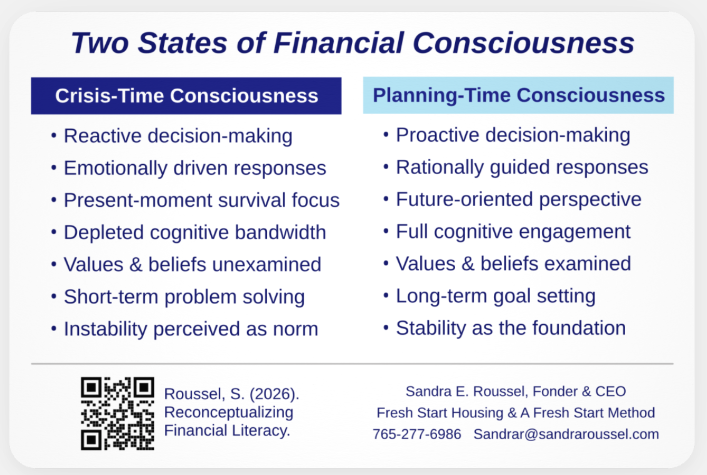
So case managers make referrals based on whichever definition they happened to encounter first, and clients end up in workshops that have nothing to do with their actual crisis. It’s not that anyone is doing a bad job. It’s that the field hasn’t agreed on what job we’re actually supposed to be doing for people in survival mode versus people in stability mode.
I don’t think this gets fixed by writing a better worksheet. I think it gets fixed by naming, explicitly, that crisis-informed financial literacy and generic financial literacy are two different bodies of knowledge — and building referral pathways that actually reflect that difference.
If you work in referrals or case management: how often have you seen a mismatch like this play out?
source: Author Sandra Roussel
 Author: Sandra Roussel
Copyright © 2009-2026 Sandra Roussel. Reproduction and distribution of all materials without written permission is strictly prohibited. All rights reserved.